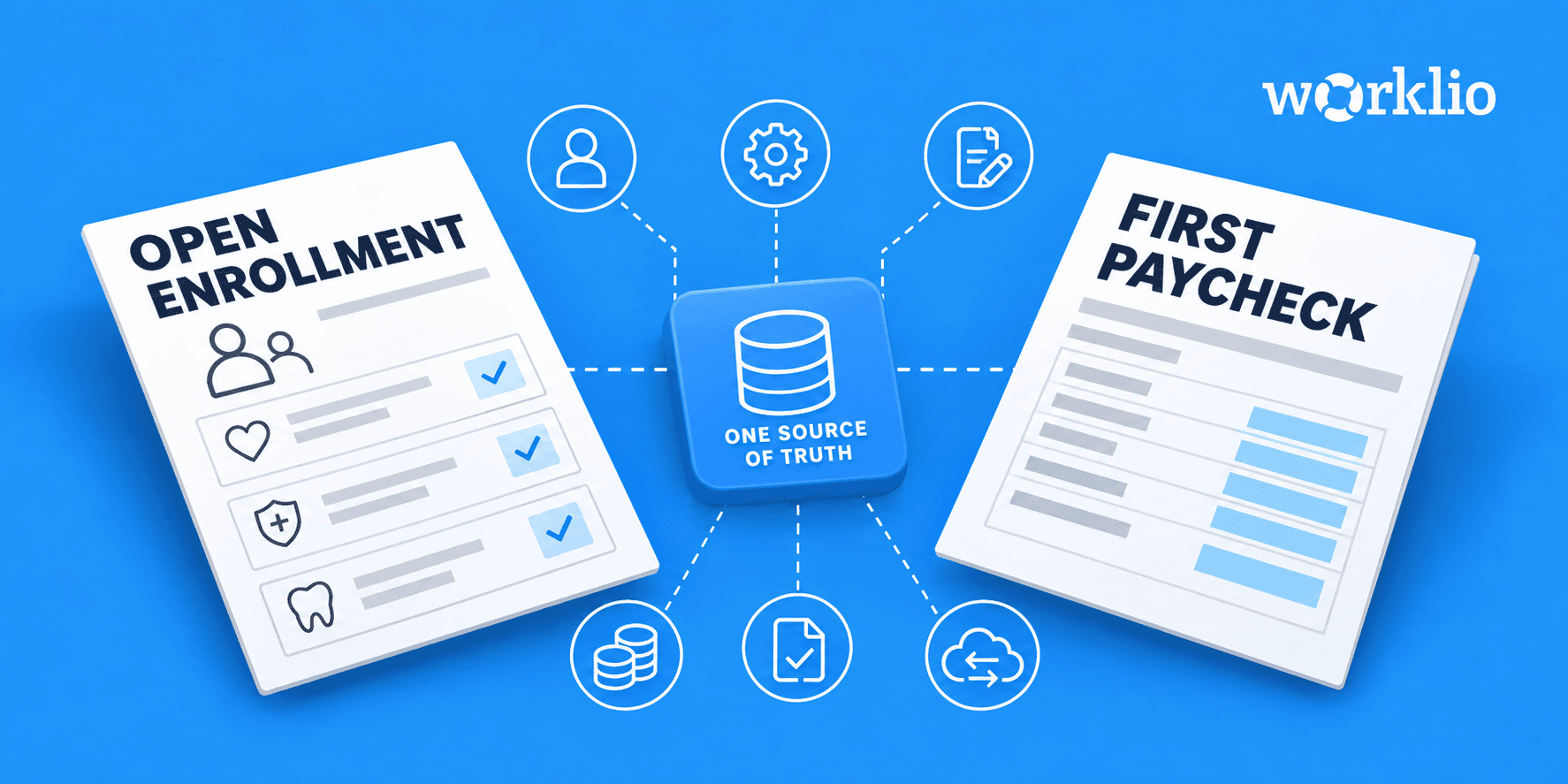
Open enrollment is done when the first paycheck takes the right deduction and the carrier bill reconciles. These seven checkpoints follow one election from plan setup to the monthly bill, for PEOs, ASOs and payroll bureaus.
An employee picks a health plan, adds dependents and submits the election on time. Then the first paycheck shows an unexpected deduction, and the employee asks: “Why is my pay different?”
First, settle whose plans they are. A PEO sponsors benefits under its master plan; the clients of an ASO or a payroll bureau hold their own. That decides who answers to the carrier and who owns each checkpoint.
Why do separate systems give different answers?
When employee records, plans, enrollment, payroll and reconciliation live in separate products, each keeps its own copy of the same facts. A dependent is added in one application, a coverage tier changed in another. Payroll keeps the old deduction, the carrier gets a file from a third record, and the records no longer agree.
That is a control problem, not an inconvenience: every re-keying is a chance for the copies to drift, and the difference surfaces on a paycheck or a carrier bill. Integrations move the data, but someone still manages the mappings and the exceptions.
Worklio brings the connected functions into one product
- Employee records give benefits and payroll the same employee data.
- Health & Insurance Plans set the plans, benefit groups, tier types and contribution rules with premium rate tables.
- Benefits Enrollment captures elections in self-service open enrollment and turns them into payroll deductions.
- Qualifying life events handle eligibility and dependent changes after enrollment closes.
- Carrier feeds send enrollment and coverage changes to the carriers.
- Benefit Reconciliation & Arrears compares coverage, deductions and carrier bills, and tracks and recovers arrears.
With payroll, they share one system of record. Accurate setup, an owner for each step and a watch on the carrier feeds are still needed.
Checkpoint 1 of 7
Start with the rules behind the election
Before employees compare plans, confirm for each client what they can choose and what they pay: eligibility groups, plans, coverage tiers, rates, employer contributions and effective dates, and how waived or missing elections are handled.
Confirm the tax treatment too. A premium taken pre-tax under a written Section 125 plan lowers the wages that federal income tax and FICA are calculated on (state treatment varies); an after-tax premium does not. That is often part of the answer to “Why is my pay different?”
Check familiar renewals as well: a changed contribution or an outdated rate gives a deduction that looks reasonable and is still wrong.
Checkpoint 2 of 7
Why do coverage dates and deduction dates differ?
Because coverage runs on the plan calendar and deductions on the payroll calendar. A client may collect premiums in advance, and a payroll run before the new plan year may have a check date after coverage begins.
Document for each client which date drives the payroll setup, when the prior deduction stops and how the transition works.
For example
If coverage begins January 1 and the employer collects premiums in December, waiting until January to start deductions would miss the intended collection period. The correct setup depends on the client’s documented schedule.
Checkpoint 3 of 7
How much should each paycheck deduct?
Start from the annual amount. An illustrative employee deduction of $240 a month is $2,880 a year, and each pay schedule divides it differently:
| Pay schedule | Deductions a year | Per deduction |
|---|---|---|
| Weekly | 52 | $55.38 |
| Biweekly | 26 | $110.77 |
| Biweekly, no deduction on the third check of a three-paycheck month | 24 | $120.00 |
| Semi-monthly | 24 | $120.00 |
Rounded amounts leave a few cents to true up over the year.
Check extra paydays, off-cycle checks and mid-year enrollments, and whether an election is a monthly, annual or per-paycheck amount. Worklio turns the election into the payroll deduction, so nobody re-keys it.
Checkpoint 4 of 7
How do you know the carrier has the enrollment?
Only when the carrier confirms it. Track submitted records, rejections, missing dependent details and confirmations until each one is resolved, not until the file is sent.
- A missed carrier handoff can leave payroll collecting deductions while coverage remains unresolved.
- A missed payroll handoff can leave coverage active without the intended employee deductions.
Name an owner for each side: the PEO under its master plan, or whoever an ASO client’s service agreement names. Worklio’s enrollment error reporting shows which records still need attention.
Checkpoint 5 of 7
Review the first affected payroll before approval
The first payroll with new elections is the last chance to catch a difference before employees do. Review the whole register, not only the deductions: benefit changes reach taxable wages and net pay, and the register review is the strongest single control in payroll.
Look closely at changed plans, new dependents, waivers, new employer contributions and rate increases, and at new hires, employees on leave and late approvals.
Decide in advance what happens when pay cannot cover a deduction: it is either carried forward as arrears and recovered later, or not taken, which leaves a variance against the carrier bill. Worklio tracks and recovers arrears automatically.
Checkpoint 6 of 7
Give employees a clear explanation
Tell each employee what they elected, what they will contribute per paycheck and from when. Worklio sends enrollment emails and reminders from six templates.
Explain the months that look different: on a biweekly payroll with 24 premium deductions over 26 checks, the third check in a three-paycheck month carries none, and employees who are not told expect an error.
A clear confirmation gives employees a reference for their first paycheck and gives support one consistent answer.
Checkpoint 7 of 7
Why don’t the carrier bill and the deductions match?
Because they measure different things. The bill is the total premium; employee deductions are only part of it, employer contributions make up the rest, and collection timing can put a deduction and its coverage month on different bills.
Reconcile them every month, with one owner and a target completion date, not once on the first bill. Compare each bill with coverage records and deductions, investigate each variance (dates, tiers, terminations, retroactive changes) and record its owner and the fix.
At year-end, reconcile benefits against W-2 boxes 12 and 14. Worklio imports premium bills and reports the discrepancies.
A checklist before the first paycheck
Confirm eligibility, rates, coverage tiers and employer contributions for each client.
Confirm whether each premium is taken pre-tax or after-tax.
Document coverage dates and deduction start and stop dates.
Confirm the number of deductions a year and the rounding.
Resolve incomplete elections, pending approvals and carrier rejections.
Review the full register before approving the first affected payroll.
Decide what happens when pay cannot cover a deduction.
Send each employee a confirmation that explains any month with a different deduction.
Name one owner for the monthly carrier bill reconciliation.