
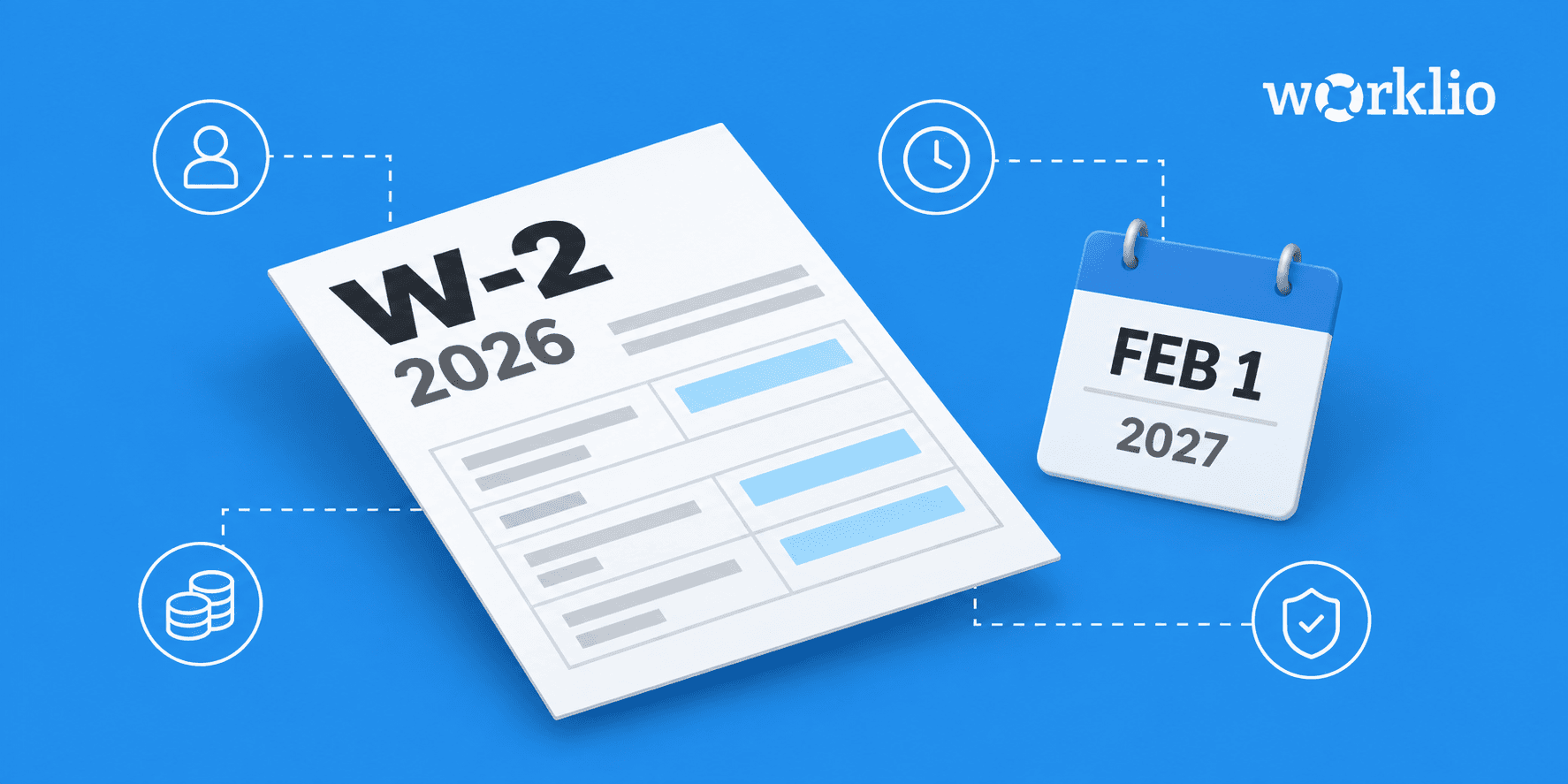
New reporting for cash tips, qualified overtime, Trump account contributions, and Treasury Tipped Occupation Codes requires payroll providers and employers to update data mappings, controls, and reconciliation before year-end.
Year-end W-2 work begins long before forms are generated. Employers must validate employee records, taxable wages, deductions, benefits, taxes, tips, overtime, fringe benefits, and state and local reporting. Payroll providers, PEOs, ASOs, and embedded payroll platforms must control the same work across many employers, EINs, jurisdictions, and source systems.
The 2026 Form W-2 adds reporting for cash tips, qualified overtime, and qualifying employer contributions to Trump accounts. It also creates Box 14b for Treasury Tipped Occupation Codes, changes a limited wage-reporting threshold, and adds W-2 treatment for certain State Paid Family and Medical Leave amounts.
These changes affect data capture and system configuration throughout the year. Begin the review before the final payroll closes and missing data turns into corrections.
What's new
Six Form W-2 changes to prepare for in 2026
The 2026 Form W-2 introduces six changes that deserve early attention. They affect data capture, payroll configuration, reporting populations, reconciliation, and employee communication.
Qualified overtime uses new Box 12 Code TT
For 2026, employers report the total amount of qualified overtime compensation in Box 12 using Code TT. Qualified overtime is compensation above the employee’s regular rate that is required under section 7 of the Fair Labor Standards Act. In a standard time-and-a-half arrangement, Code TT generally reports only the additional half-time premium, not total overtime pay.
Example
An employee works four overtime hours at a $20 regular rate. Total overtime pay is $120. The amount reported under Code TT is $40, assuming the overtime is required by the Fair Labor Standards Act.
Qualified overtime compensation generally remains subject to federal income tax withholding and employer and employee Social Security and Medicare taxes. The new provision concerns an employee income tax deduction; it does not make overtime wages tax free.
Cash tips reported to the employer use new Box 12 Code TP
For 2026, use Box 12 Code TP to report the total cash tips reported to the employer. Do not label the Code TP amount as qualified tips; eligibility for an employee deduction is a separate determination.
Tips generally remain subject to federal income tax withholding and employer and employee Social Security and Medicare taxes when the employee receives $20 or more in tips during the month. Payroll teams should verify that tip data flows from point-of-sale, tip-management, and payroll systems throughout the year instead of reconstructing it at year-end.
Box 14a keeps other information and Box 14b adds occupation codes
Information previously reported as Box 14 Other moves to Box 14a. When Box 12 includes Code TP, Box 14b must contain the applicable Treasury Tipped Occupation Code or codes.
Employers may enter up to two occupation codes. If any reported tips came from a nonqualifying occupation, code 000 must be one of the entries. Employers should validate job and occupation data before forms are generated.
Employer Trump account contributions use new Box 12 Code TA
Beginning July 4, 2026, qualifying employer contributions made under a section 128 Trump account contribution program to the Trump account of an employee or an employee’s dependent are reported in Box 12 using Code TA.
The employer contribution may be up to $2,500 a year, subject to the program requirements, and it counts toward the account’s overall annual contribution limit of $5,000. Both figures are indexed for inflation after tax year 2027.
Employers offering the contribution need payroll and benefits systems to capture the reportable amount for each employee.
A limited wage-reporting threshold increases to $2,000
For wages paid after calendar year 2025, the wage-reporting threshold increases from $600 to $2,000 only when no federal income, Social Security, or Medicare tax was withheld. This is not a blanket Form W-2 threshold increase.
Payroll teams should test the employee-population logic used to determine who receives a Form W-2. The threshold will be adjusted for inflation after 2026.
State paid family and medical leave amounts need W-2 review
The 2026 instructions require State Paid Family and Medical Leave employee contributions and employer voluntary payments to be included as wages on Form W-2.
Payroll teams should review IRS Notice 2026-6, Revenue Ruling 2025-4, and applicable state guidance before finalizing system configuration and reporting.
Timing
Start W-2 preparation before the final payroll
January is too late to discover missing occupation codes, incorrect employee details, or unmapped qualified overtime. Complete data, ownership, and system checks before the final payroll of 2026.
The year-end review should cover:
Employee legal names, Social Security numbers, addresses, work locations, and tax jurisdictions
Employer legal name, EIN, state and local tax accounts, and filing responsibilities
Year-to-date wages and taxes, deductions, benefits, taxable fringe benefits, bonuses, third-party sick pay, and paid leave
Cash tips, Treasury Tipped Occupation Codes, and the FLSA-required overtime premium reported under Code TT
The Form W-2 population, including the limited $2,000 wage-reporting threshold
Electronic-delivery consents, the February 1, 2027 deadline, and separate state and local deadlines
For payroll providers and embedded platforms, the review must also trace each required field to its source system. Cash tips may begin in a point-of-sale or tip-management system, overtime may begin in timekeeping, and occupation codes may begin in HR or job records. Confirm the data mapping and exception path before year-end.
Finding an incorrect Social Security number or incomplete mapping in November gives the team time to resolve it. Finding the problem after filing can require additional work and Form W-2c corrections.
Verification
Reconcile and approve before filing
Generating a Form W-2 does not prove that its underlying data is correct. Assign a filing owner and an internal approval date, then reconcile payroll and tax records before submission.
The final review should include:
Gross and taxable wages, including Social Security and Medicare wages
Federal, state, and local withholding
Forms W-2 and W-3 compared with Forms 941, 943, or 944, as applicable
Payroll registers compared with tax deposits
Retirement, health savings account, flexible spending account, fringe benefit, bonus, commission, third-party sick pay, and paid leave reporting
Code TP and Box 14b totals, plus qualified overtime under Code TT
Unresolved exceptions, correction ownership, and final filing approval
A payroll provider or platform should make these checks visible by employer and EIN so operations teams can identify incomplete clients before the filing deadline.
Employee questions
Why doesn’t the W-2 match the employee’s last paystub?
Get ready for this question. Employees frequently assume their W-2 should match the gross earnings displayed on their final paystub. But those numbers can legitimately differ.
Pre-tax deductions, retirement contributions, taxable fringe benefits, third-party sick pay, employer-paid benefits, year-end adjustments, and differences among federal, Social Security, and Medicare taxable wages can all affect what appears on Form W-2.
Example
Traditional 401(k) elective deferrals generally reduce federal taxable wages reported in Box 1, but do not reduce Social Security or Medicare wages. That’s one reason Boxes 1, 3, and 5 may not match.
The new tip and overtime provisions concern deductions on an employee’s income tax return. They do not make tips or overtime tax-free wages, and those amounts generally remain subject to payroll tax rules.
Explain these differences before forms are distributed to reduce avoidable questions in January and February.
Shared responsibility
Give employees a clear verification deadline
Before forms are generated, ask employees to confirm their legal name, Social Security number, mailing address, year-to-date earnings, withholding, retirement and benefit deductions, and W-2 delivery preference by a stated internal deadline.
Tell employees how to report a discrepancy and when corrections can still be made before filing. A clear year-end message can prevent avoidable Form W-2c work later.
Key dates
Confirm the February 1, 2027 deadline
Deadline
Feb 12027Because January 31, 2027 falls on a Sunday, the general deadline to furnish 2026 Forms W-2 to employees and file them with the Social Security Administration is February 1, 2027.
Federal electronic filing is generally required when an employer must file at least 10 covered information returns in aggregate. Review the included return types, exclusions, waiver rules, and the separate treatment of corrected returns.
Extensions are not automatic. State and local filing deadlines and requirements may differ and should be confirmed separately.
For returns due after December 31, 2026, failure-to-file penalties can be $60, $130, or $340 per Form W-2 depending on when a correct form is filed. Intentional disregard starts at $690 per form with no maximum. Separate penalties can apply for failing to furnish correct employee statements.
Each per-form tier is capped for the year: $698,500 at the $60 tier, $2,095,500 at $130, and $4,191,500 at $340. A small business, meaning average annual gross receipts of $5 million or less across the three most recent tax years, is capped at $244,500, $698,500, and $1,397,000. The caps are indexed for inflation, so confirm the figures that apply to the filing year.
Action plan
Turn the rules into a controlled year-end process
Accurate Forms W-2 depend on clean source data, correct mappings, reconciled totals, assigned owners, and resolved exceptions. For one employer, that is an annual workflow. For a payroll provider or embedded platform, it is the same workflow repeated across many employers, EINs, jurisdictions, and systems.
Use the employer checklist below to complete the form-level review. Then use the provider and platform checklist to test whether the current operating model can manage readiness across the client portfolio.
Readiness tool
2026 Form W-2 employer readiness checklist
Complete each section before processing the final payroll of 2026. Select an item when it is complete.
Your progress is saved in this browser. Copy the link to share it with your team.
0 of 30 complete
For payroll providers and embedded platforms
Managing 2026 W-2 readiness across a client portfolio
Every employer-level item becomes harder when it must be managed across hundreds of employers, multiple EINs, different jurisdictions, and several upstream systems. Payroll providers, PEOs, ASOs, and embedded platforms need centralized readiness tracking, reliable data mappings, exception management, reconciliation, and correction workflows across the client portfolio.
Use these six checks to evaluate platform readiness:
The 2026 Form W-2 schema is supported across every employer environment
Codes TP, TT, and TA and Box 14b data are mapped from authoritative source systems
Client-level readiness, missing data, and exceptions are visible centrally
Form W-2, Form W-3, and employment-tax return reconciliation is supported
Federal, state, and local filing responsibilities are defined by employer
Form W-2c corrections and audit history are supported
Sources
This article reflects federal guidance available as of September 2026 and is provided for general educational purposes. It is not tax, legal, accounting, or financial advice. Employers and payroll providers should review current IRS, SSA, state, and local requirements and consult qualified professionals when appropriate.